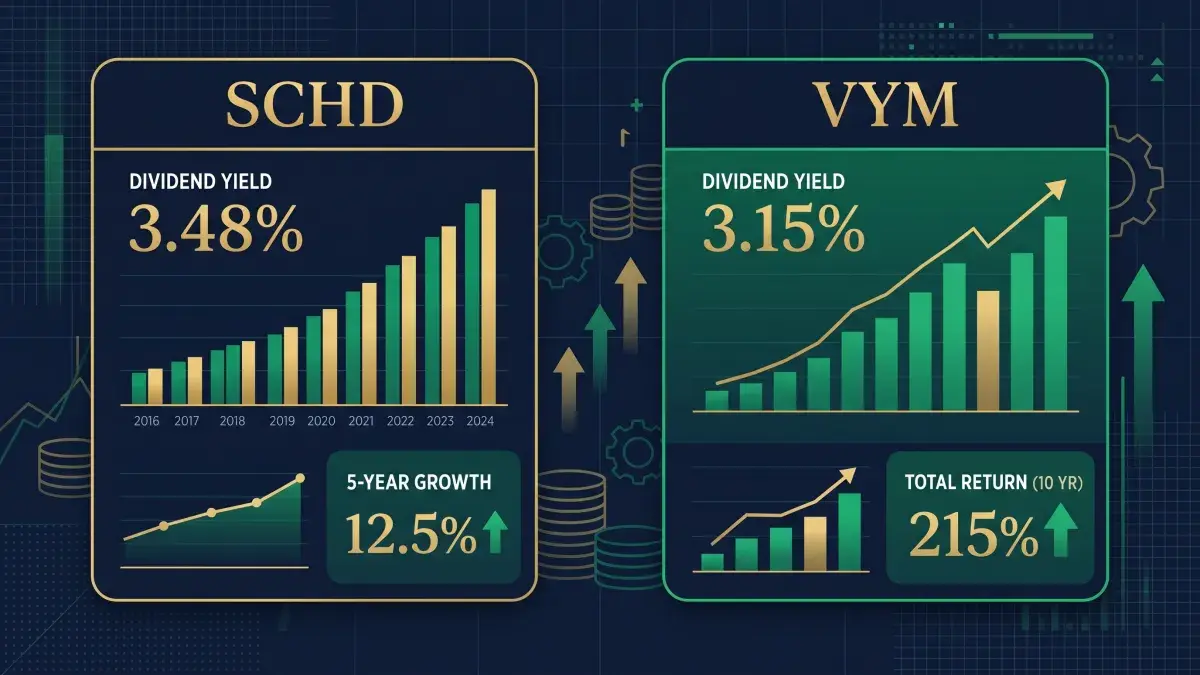
SCHD and VYM are the two dividend ETFs that show up in nearly every “best dividend fund” conversation in 2026. They charge the exact same expense ratio — 0.06% — so cost is a wash. But they are built on fundamentally different indexes, and that difference drives everything that actually matters: yield, concentration, sector tilt, dividend-growth profile, and total return. One is a focused quality screen; the other is a broad high-yield basket. Picking between them is a methodology decision, not a price decision.
This article works through the data: 30-day SEC yield, holdings count, index construction, sector weights, top holdings, and trailing total return — sourced from Schwab Asset Management’s SCHD page, Vanguard’s VYM page, the S&P Dow Jones and FTSE Russell index methodology documents, and Morningstar. All market-sensitive figures are as of early June 2026 and labeled as illustrative current-range values; verify the live numbers on the issuer pages before allocating.
The Headline Numbers (early June 2026)
| Metric | SCHD | VYM |
|---|---|---|
| Issuer | Schwab | Vanguard |
| Expense ratio | 0.06% | 0.06% |
| Index tracked | Dow Jones US Dividend 100 | FTSE High Dividend Yield |
| Holdings (approx.) | ~100 | ~530 |
| 30-day SEC yield (illustrative) | ~3.6% | ~2.8% |
| AUM (approx.) | ~$62B | ~$60B |
| Distribution frequency | Quarterly | Quarterly |
| Single-name cap | 4% | None (market-cap weighted) |
| Sector cap | 25% | None |
| REITs included | No | No |
| Inception | Oct 2011 | Nov 2006 |
| Weighting | Modified market cap, factor-tilted | Float-adjusted market cap |
Expense ratios verified on each issuer’s fund page (source: schwabassetmanagement.com/SCHD and investor.vanguard.com/VYM). Yields and AUM drift daily with market moves and net creations — treat them as directional. Holdings counts and index methodology are stable between reconstitutions.
The Core Difference: Two Very Different Indexes
Everything about how SCHD and VYM behave traces back to the index each one tracks. They are not minor variations on the same idea.
SCHD tracks the Dow Jones US Dividend 100 Index (S&P Dow Jones Indices). The methodology starts with US-listed companies that have paid dividends for at least 10 consecutive years, excludes REITs, then screens the remaining universe on four fundamental factors: free-cash-flow to total debt, return on equity, indicated dividend yield, and 5-year dividend growth rate. The 100 highest-scoring names are selected and weighted by modified market cap, with a 4% cap on any single stock and a 25% cap on any sector. This is a quality-and-growth screen that happens to produce yield, not a pure high-yield grab.
VYM tracks the FTSE High Dividend Yield Index (FTSE Russell). The methodology ranks all US common stocks (excluding REITs) by expected forward dividend yield, then includes names from the top until the cumulative basket reaches roughly half of the total market cap of the dividend-paying universe. The result is a much broader portfolio — around 530 stocks — weighted by float-adjusted market cap with no single-name or sector caps. VYM is a yield-ranking exercise, not a fundamental quality screen.
The practical consequence: SCHD is selective and concentrated; it can miss entire slices of the market that do not pass its quality factors. VYM is inclusive and broad; it will hold almost any large dividend payer, including lower-quality high yielders that SCHD’s screen would reject. SCHD trades breadth for a quality filter. VYM trades the filter for breadth.
Yield: SCHD Usually Edges Ahead
Despite VYM having “High Dividend Yield” in its name, SCHD has generally carried the higher 30-day SEC yield in recent years. As of early June 2026, SCHD’s SEC yield sits in the ~3.6% range (illustrative) versus VYM’s ~2.8% (illustrative). The reason is structural: VYM’s market-cap weighting pulls large, relatively lower-yielding megacaps toward the top of its basket, which dilutes the headline yield, while SCHD’s factor tilt deliberately weights toward higher-yielding quality names within its 100-stock universe.
This ranking is not permanent. In years when megacap value names re-rate or SCHD’s sector tilts shift at reconstitution, the gap narrows or occasionally flips. But the multi-year pattern has favored SCHD on current yield. Either way, both are real qualified-dividend yields from US common stock — not the option-premium yield you get from a covered-call fund. For that very different income mechanism, see our SCHD vs JEPI income ETF showdown, which breaks down why JEPI’s ~7-8% headline yield is taxed and structured nothing like SCHD’s.
Dividend Growth: SCHD’s Real Edge
Current yield is only half the income story. The other half is how fast that income stream grows. This is where SCHD’s methodology shows its hand: the 5-year dividend growth rate is one of the four factors in its index screen, so the fund systematically tilts toward companies actively increasing their payouts. SCHD’s trailing per-share dividend growth has historically run in the high-single-digit to low-double-digit annual range — faster than VYM’s.
VYM does not screen for dividend growth at all. It ranks on yield and weights on market cap, so its distribution growth tracks the blended payout behavior of a very broad basket — steadier and more diversified, but slower-growing on a per-share basis. For a long-horizon accumulator who cares about the income stream ten or twenty years out, SCHD’s growth tilt is the more compelling attribute. For an investor who values a wide, stable basket over maximum growth, VYM’s breadth is the draw.
Sector Weights: Concentration vs Breadth
The two funds tilt toward different parts of the market. SCHD’s quality screen and 25% sector cap concentrate it in financials, energy, consumer staples, healthcare, and industrials, with essentially zero weight in the zero-yielding mega-cap growth names. VYM’s broader basket leans more heavily on financials and includes a meaningful utilities sleeve plus some lower-yielding large caps that SCHD omits. Approximate sector weights as of early 2026:
| Sector | SCHD (approx.) | VYM (approx.) |
|---|---|---|
| Financials | ~17% | ~22% |
| Energy | ~13% | ~9% |
| Consumer staples | ~14% | ~9% |
| Healthcare | ~13% | ~14% |
| Industrials | ~12% | ~11% |
| Technology | ~9% | ~9% |
| Consumer discretionary | ~8% | ~7% |
| Utilities | ~0% | ~8% |
| Communication services | ~5% | ~5% |
| Materials / other | ~5% | ~6% |
Sector weights approximated from the funds’ monthly holdings disclosures on schwabassetmanagement.com and investor.vanguard.com; weights shift with price moves and annual reconstitution. The standout difference is utilities — SCHD’s index methodology effectively leaves the sector out, while VYM carries a full ~8% weight. SCHD’s consumer-staples and energy tilts also run heavier than VYM’s, a direct consequence of its yield-and-quality factor weighting.
Top Holdings: Overlapping but Not Identical
Because both pull from the US large-cap dividend universe, their top holdings overlap on many of the same blue-chip payers — names across energy, staples, healthcare, financials, and industrials. But the weights differ sharply. SCHD’s 4% single-name cap and 100-stock universe push its top-10 to roughly 40% of the fund, a genuinely concentrated profile. VYM’s 530-stock, uncapped market-cap weighting spreads its top-10 to roughly 25% of the fund, with larger megacaps sitting at the top because of their sheer size rather than their yield.
The upshot: SCHD gives you a punchier, more concentrated bet on its highest- conviction quality dividend payers, while VYM gives you a diluted, broader exposure where any single holding matters less. Exact top-10 composition for both changes at reconstitution and with market moves — you can see current live weights on each fund’s issuer page.
Total Return: SCHD Has Generally Led
Yield and growth are inputs; total return is the output that compounds your wealth. Over the trailing windows ending in early 2026, SCHD has generally outpaced VYM, helped by its higher yield and dividend-growth tilt. Both have trailed the broad S&P 500 — expected behavior for a dividend-tilted strategy that excludes the highest-returning non-dividend growth names.
| Period | SCHD (approx.) | VYM (approx.) | S&P 500 ref. |
|---|---|---|---|
| 1-year total return | ~11% | ~10% | ~18% |
| 3-year annualized | ~8% | ~7.5% | ~10.5% |
| 5-year annualized | ~11% | ~10% | ~13% |
| 10-year annualized | ~11.5% | ~10% | ~13% |
Return figures are illustrative approximations from Morningstar total-return data as of early 2026 (source: morningstar.com fund pages for SCHD and VYM) and will change with market conditions. The directional pattern — SCHD modestly ahead of VYM, both behind the S&P 500 — has held across most recent windows, though individual calendar years have flipped the SCHD/VYM ranking when SCHD’s sector tilts fell out of favor. Past performance does not predict future results; the methodology difference is more durable than any single return number.
Tax Treatment: Both Are Clean
This is a tie, and a favorable one for both funds. SCHD and VYM hold US common stocks, so their distributions are overwhelmingly qualified dividends — taxed at long-term capital gains rates (0%, 15%, or 20% by bracket, plus the 3.8% net investment income tax for high earners) as long as you meet the holding period. Typically 95%+ of each fund’s distribution qualifies. Neither has distributed material capital gains in recent memory thanks to the in-kind creation/redemption mechanism that lets ETFs flush low-basis shares without triggering taxable events.
That makes both far more tax-efficient in a taxable brokerage account than a covered-call income ETF, whose option-premium distributions are taxed as ordinary income. If you want to gut-check your marginal and qualified-dividend rates before modeling after-tax income, our money.thicket.sh tax and finance tool set covers bracket math and after-tax yield estimation.
When Each One Actually Wins
SCHD is the better pick if:
- You want a higher current yield with a quality screen behind it.
- You value dividend growth — you are building an income stream that compounds over decades.
- You are comfortable with a concentrated, factor-driven 100-stock portfolio.
- You want the fund to actively exclude lower-quality high-yield traps.
VYM is the better pick if:
- You want maximum diversification within a dividend tilt — ~530 holdings versus ~100.
- You prefer a broad, market-cap-weighted basket over a concentrated factor bet.
- You want exposure to utilities and a wider slice of the dividend universe.
- You are a Vanguard loyalist and want VYM alongside other Vanguard core funds.
Do not stack both expecting more diversification. VYM already holds most of SCHD’s universe and then some. Owning both mostly dilutes SCHD’s quality screen with VYM’s broader basket. If you want a dividend tilt plus genuine diversification, pair one of these with a total-market fund instead — see our VTI vs VOO 2026 deep dive for the total-market core options, or use the SCHD vs VYM comparison tool to see live expense ratios, yields, holdings, and sector weights side by side.
Compare Them Side by Side
FundDuel’s comparison tools pull live expense ratios, yields, holdings, and sector allocations for any pair head-to-head:
- SCHD vs VYM comparison — the two dividend ETFs in this article, side by side.
- SCHD vs VOO comparison — dividend quality vs pure S&P 500.
- VYM vs VOO comparison — high dividend yield vs the broad large-cap index.
Related reading: the VOO vs SPY vs IVV (2026) breakdown if you are choosing an S&P 500 core to pair with a dividend tilt, and the ETF vs mutual funds 2026 analysis on why the wrapper itself matters for tax efficiency.
Caveats
All yield, AUM, sector-weight, and return figures in this article are illustrative current-range values as of early June 2026 and will drift with market moves, net creations, and the funds’ annual reconstitutions. Expense ratios (0.06% for both) and the underlying index methodologies are stable. Before committing capital, verify the current 30-day SEC yield and holdings directly on the issuer fund pages — Schwab Asset Management for SCHD and Vanguard for VYM — and the index construction rules in the S&P Dow Jones and FTSE Russell methodology documents linked above. Those are the authoritative sources; third-party data occasionally lags fund changes. Nothing here is investment advice.