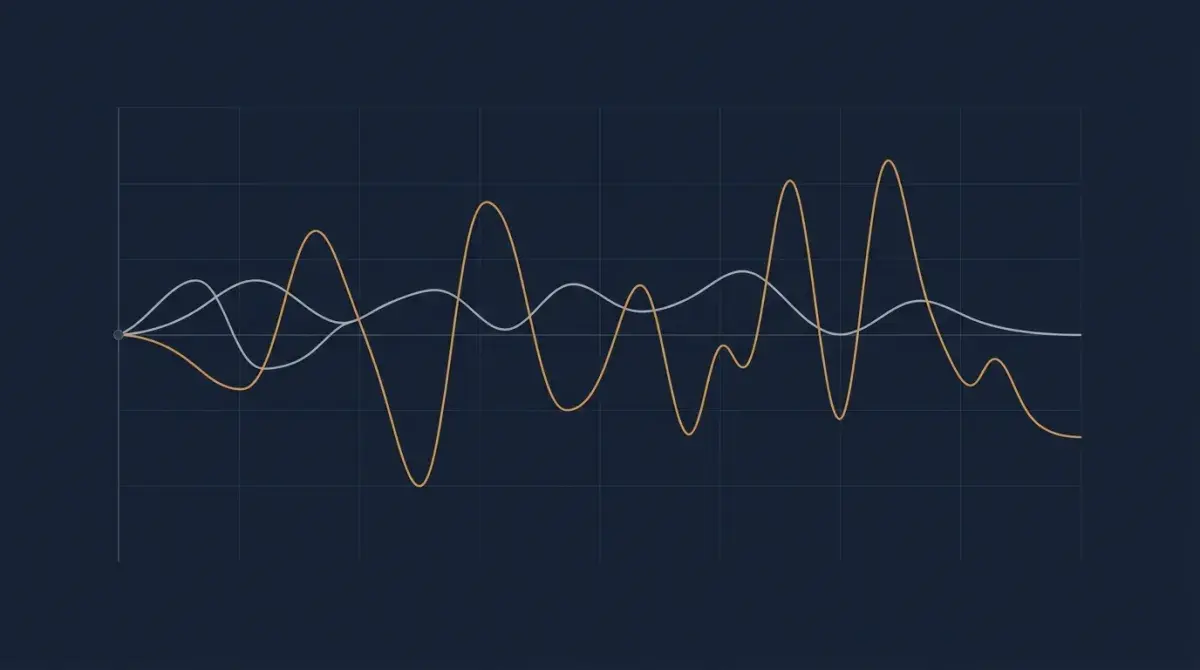
A 2x fund promises twice the daily return and delivers it every single day. Nothing is skimmed and no fee explains what follows. Hold it longer than a day and those daily results compound against each other, and the product of the daily moves is not the multiple of the total move. On a choppy path that gap costs you badly. On a smooth one it pays you more than 2x. Holding leverage is a bet on the path, not just the direction.
The one-line cause
Take an index at 100. It rises 10% to 110, then falls 10% to 99. The index is down 1%, because the 10% fall was taken on a bigger number than the 10% rise. Now a 2x fund on the same two days: up 20% to 120, then down 20% to 96. Down 4%, against an index down 1%. A 3x fund: up 30% to 130, then down 30% to 91 — down 9%.
Each fund did exactly what it advertised on both days. The gap is not a failure to track. It is what happens when you multiply daily returns together instead of adding them up.
Twenty days of it
One round trip is a rounding error. The effect is worth understanding because it accumulates. Both rows below are the same alternating up-down pattern repeated over twenty trading days — a market going nowhere, loudly.
| Daily swing | Index after 20 days | 2x fund | 3x fund |
|---|---|---|---|
| ±5% | −2.47% | −9.56% | −20.35% |
| ±10% | −9.56% | −33.52% | −61.06% |
In the first row the index is essentially flat and a 3x holder has lost a fifth of their money. In the second the index is down single digits and a 3x holder has lost most of it. Every one of those days, the fund tracked its benchmark perfectly.
The half nobody quotes
The same arithmetic runs the other way on a trending path, and leaving this out is how “decay” gets mistaken for a defect rather than a property. Suppose the index rises 10% over ten days in a straight line — about 0.958% a day, no down days at all.
| Fund | Naive expectation | Actual |
|---|---|---|
| 2x | +20.00% | +20.89% |
| 3x | +30.00% | +32.74% |
Same mechanism, opposite sign. Daily compounding in a trend means each day’s gain is levered on a larger base than the day before. So the accurate statement is not that leveraged funds bleed value — it is that they convert the smoothness of a path into return, and punish its roughness. Direction alone does not tell you whether you won.
How big, roughly, in advance
For continuously rebalanced leverage there is a standard approximation for the drag: L(L−1)/2 × σ² per unit of time, with L the multiple and σ the volatility of the underlying. It is an approximation, not a guarantee, but it is enough to size the risk before you take it.
| Underlying volatility | 2x drag / year | 3x drag / year |
|---|---|---|
| 20% (a calm broad index) | ~4% | ~12% |
| 40% (stressed, or a single sector) | ~16% | ~48% |
Two things follow, and they are the practical takeaways. Drag scales with the square of volatility, so a market that gets twice as choppy costs you four times as much. And it grows faster than the multiple: 3x is not one and a half times the exposure of 2x, it is three times the drag.
Why the fund can’t just promise 2x for the year
This is the question worth answering, because it is usually treated as a loophole. It is not. A fund that delivered twice a period’s return would have to know when the period starts and ends, and could not be freely bought and sold in between — the exposure each holder needs depends on when they bought in. Resetting daily is what lets one fund serve everyone who trades it at any moment. The daily objective is not fine print concealing a flaw; it is the only objective a continuously traded leveraged fund can actually meet, and issuers state it plainly.
What to actually do with this
- Read the objective, not the name. “2x” in a fund’s title refers to a daily target. The prospectus says so, and says returns over longer periods will likely differ from the multiple of the index return.
- Size it by volatility, not by conviction. Use L(L−1)/2 × σ² to estimate what a sideways market costs you before you need to be right about direction.
- Treat the holding period as part of the position. A leveraged fund held for a day does what it says. Held for a quarter it is a different instrument with a different payoff.
- Do not use it as a lazy way to hold more of an index. If the goal is more exposure to a broad market over years, the compounding works against you precisely when markets are rough — which is when you least want it. The wrapper’s other real drawbacks are small by comparison, and that is the point.
Frequently asked
What is leveraged ETF decay?
The gap that opens between a leveraged fund's return and the multiple of its index's return, once you hold it longer than a day. It is not a fee and nothing is being taken from you — it falls out of compounding. A 2x fund promises twice the DAILY return and delivers exactly that every day; those daily results then compound against each other, and over any period longer than one day the product of the daily moves is not the multiple of the index's total move. The effect is often called volatility decay or beta slippage, and its size depends on how choppy the path was, not on how long you held.
How much does a leveraged ETF lose in a flat market?
It depends entirely on the volatility of the path, and the arithmetic is easy to check. Take an index that moves +5% and -5% on alternating days for twenty trading days. The index itself ends down 2.47% — already slightly negative, because a 5% gain does not undo a 5% loss. A 2x fund on that path ends down 9.56% and a 3x fund down 20.35%. Make the swings 10% instead of 5% and over the same twenty days the index is down 9.56%, the 2x fund down 33.52%, and the 3x fund down 61.06%. Nothing was charged. That is compounding.
Does decay always hurt? Can a leveraged ETF beat 2x?
It can, and this is the part most explanations leave out. The same compounding that punishes a choppy path rewards a smooth one. If an index rises 10% in a straight line over ten days, a 2x fund returns about 20.89% — more than 20% — and a 3x fund about 32.74%, more than 30%. In a sustained trend, leverage compounds in your favour. Calling the effect 'decay' describes the common case rather than the mechanism. The honest framing is that holding a leveraged fund is a bet on the path being smooth, not merely on the direction being right.
Why can't a 2x ETF just track twice the index over a year?
Because it would have to be a different product. To deliver twice a period's return, a fund would need to know the period's start and end in advance and could not be bought or sold in between by anyone else — the exposure each investor needs depends on when they bought. Resetting exposure daily is what makes a single fund tradable by everyone at once, and daily reset is precisely what causes the compounding gap. The prospectus states the daily objective plainly; it is not fine print or a loophole, it is the only objective a continuously traded leveraged fund can actually meet.
Is there a formula for how fast a leveraged ETF decays?
A good approximation for continuously rebalanced leverage is that the drag is L(L−1)/2 × σ² per unit of time, where L is the leverage multiple and σ is the volatility of the underlying. At 20% annual volatility that is about 4% a year for a 2x fund and about 12% for a 3x fund. At 40% volatility — a stressed market, or a single volatile sector — it becomes roughly 16% a year for 2x and 48% for 3x. Two things follow: drag scales with the SQUARE of volatility, so doubling volatility quadruples it, and it grows faster than the leverage multiple, so 3x is far more than one and a half times as exposed as 2x.
Are leveraged ETFs suitable for long-term holding?
The issuers themselves say no. These funds are marketed for daily objectives, their prospectuses state that returns over longer periods will likely differ from the multiple of the index return, and regulators have repeatedly published investor alerts making the same point. That is unusually candid disclosure and it is worth taking at face value. None of that makes them a scam — it makes them a short-horizon instrument whose behaviour over long horizons is well documented, published in advance by the people selling them, and routinely ignored.
Do fees and borrowing costs matter compared with decay?
They matter, and they are the smaller number. Leveraged funds carry higher expense ratios than plain index funds and also bear the cost of the swaps or financing that create the exposure, which rises with interest rates. But in a volatile market the compounding gap dwarfs both: the 20-day 10%-swing example above costs a 3x holder more than 60% while no plausible fee schedule costs a few percent a year. Check the fee, then understand it is not the main event.
Every figure on this page is arithmetic on a stated path, computed for this article and reproducible in a few lines of code — not an observed return of any real fund, and not a forecast. The drag formula L(L−1)/2 × σ² is the standard continuous-rebalancing approximation and is an estimate, not a guarantee. SEC and FINRA investor materials on leveraged and inverse products, and the funds’ own prospectuses, make the same daily-objective point. General information about how these products work, not investment advice.