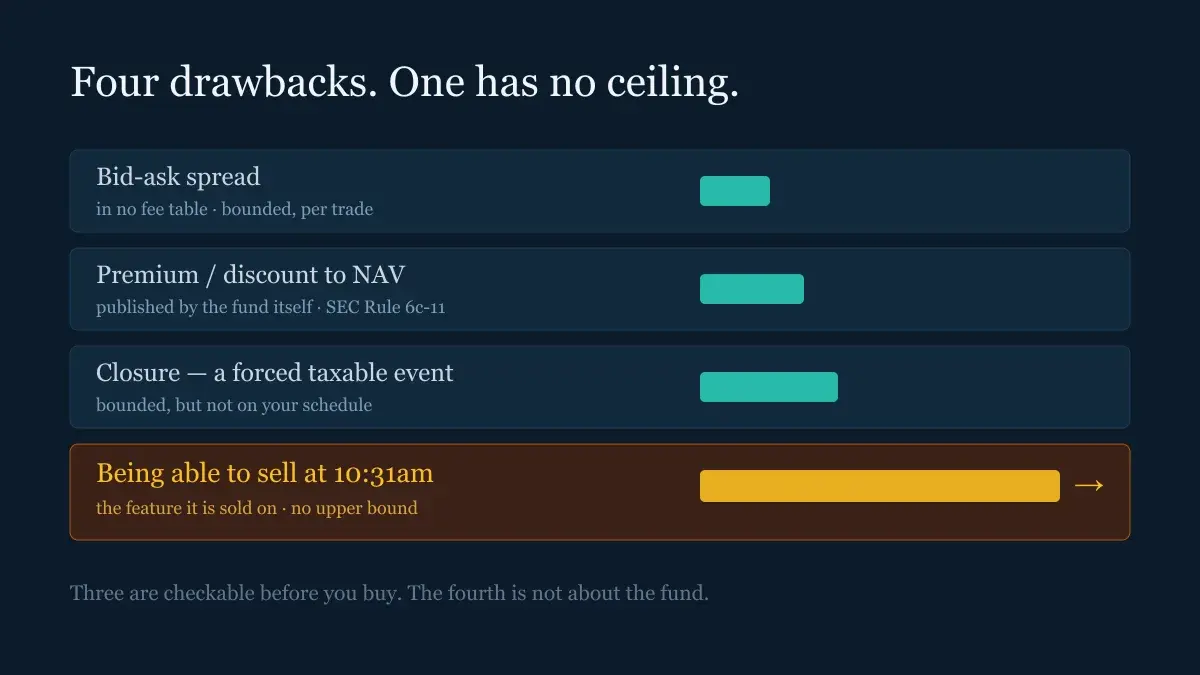
An ETF is a wrapper, not a strategy — the same three letters cover a total-market index fund and a 3x leveraged sector product built to be held for a day. So the useful question is not whether ETFs are bad, but which drawbacks belong to the wrapper, since those apply to every fund inside it. There are four. The largest is not a cost, and it is the feature the wrapper is sold on.
First, the folklore
Three of the most repeated criticisms do not survive contact with the documents, and clearing them out makes room for the ones that do.
“ETFs are riskier than mutual funds.” The wrapper does not set the risk; the holdings do. An S&P 500 index ETF and an S&P 500 index mutual fund own the same companies in the same proportions and will lose money in the same week. Where risk genuinely differs, it is because the funds are different, not because one is listed.
“You lose your money if the fund shuts down.” You do not. Liquidating shareholders either sell before the final trading day or receive a cash distribution at net asset value. There is a real harm here, but it is a timing harm — see below.
“The expense ratio is the cost.” This is the most expensive piece of folklore on the list, because it is nearly true and therefore rarely questioned. The expense ratio is a cost, accrued daily inside the fund. It is not the cost, and the missing pieces are the first two real drawbacks.
The four that are real
| Drawback | Shows up in a fee table? | Bounded? |
|---|---|---|
| Bid-ask spread | No | Yes — small, per trade |
| Premium / discount to NAV | No — but published by the fund | Usually |
| Closure — a forced taxable event | No | Yes, but not on your schedule |
| Being able to sell at 10:31am | No | No upper bound |
1. The spread is a cost that appears nowhere
You buy at the ask and sell at the bid, and the gap between them is paid to the market at the moment of the trade. It is not accrued in NAV, not itemised on a statement, and not part of any expense ratio. On a large fund traded constantly it is a rounding error. On a thin, niche fund it can cost more in a single round trip than the fund charges in management fees for the year — which means a low headline fee can be actively misleading for a fund almost nobody trades.
2. The price is not the value, and the fund tells you so
An ETF share trades at whatever the market pays, which is close to net asset value but not identical to it. The creation-and-redemption mechanism keeps the two tethered through arbitrage; it does not weld them together, and the gap tends to widen exactly when markets are stressed and the underlying holdings are hardest to price.
The genuinely useful part: SEC Rule 6c-11 requires an ETF to publish premium and discount information on its own website, including historical figures. The fund itself will tell you how far and how often its price has strayed from value. It is the best-disclosed and least-read number in the category, and checking it takes about two minutes.
3. Closure takes the timing away from you
Funds that fail to gather assets get liquidated. You keep the money — but the sale happens in the fund’s tax year rather than the one you would have chosen, realising whatever gain or loss you were sitting on. The exposure is concentrated in precisely the narrow, thematic funds that launch into enthusiasm for a theme, which is to say the ones most likely to be down when the enthusiasm passes.
4. The feature is the drawback
The ETF’s headline advantage over a mutual fund is that you can trade it all day, at a known price, immediately. A mutual fund prices once, after the close: if you decide to panic at 10:31am, the structure makes you wait until the evening, and by then a good number of people have changed their minds.
Every other item on this list is measurable and small. This one has no upper bound, because its size is set by how badly you behave in the worst week of a decade rather than by any property of the fund. It is also the one drawback that is fully within your control, and the reason it belongs on the list is that it is never counted as a cost at all.
What follows from this
Not “avoid ETFs”. Three of the four are checkable before you buy: read the spread on the quote, read the premium/discount history on the issuer’s own page, and prefer funds large enough that liquidation is not a live question. The fourth is not about the fund at all — it is an argument for owning things you are willing to hold through a bad year, in a wrapper that will happily let you not.
Related: can you lose money in an ETF, how the expense ratio is actually charged, and what happens when a fund closes.
Frequently asked
Are ETFs actually bad investments?
No, and the question is slightly the wrong shape. An ETF is a wrapper, not a strategy — the same three letters cover a total-market index fund holding thousands of companies and a 3x leveraged single-sector product designed to be held for a day. Asking whether ETFs are bad is like asking whether envelopes are bad. What is worth asking is which drawbacks belong to the wrapper itself, because those apply to every fund inside it no matter how sensible the strategy. There are four, and the largest one is not a fee.
What is the biggest real drawback of an ETF?
That you can sell it at 10:31am. Intraday tradability is the ETF's headline feature over a mutual fund, which prices once a day after the close — and it is also the only drawback with no upper bound. Every other cost here is measurable and small. The cost of selling in a panic is unbounded, and the wrapper is what makes that possible at speed. Nothing about this is a criticism of any particular fund; it is a property of being listed on an exchange, and it argues for choosing funds you are willing to hold rather than for avoiding ETFs.
Does the expense ratio include the bid-ask spread?
No. The expense ratio is accrued daily out of fund assets before NAV is struck, and it covers management and operating costs. The bid-ask spread is a separate, additional cost paid to the market at the moment you trade, and it does not appear on any statement or in any fee disclosure. On a large, heavily traded fund the spread is typically a rounding error. On a thin or niche fund it can exceed the annual expense ratio in a single round trip — which means a low headline fee can be entirely misleading for a fund almost nobody trades.
Can I check whether an ETF trades away from its true value?
Yes, and this is the most useful under-used disclosure in the category. SEC Rule 6c-11 — the rule that let most ETFs launch without individual exemptive relief — requires an ETF to publish premium and discount information on its own website, including historical data. So the fund itself tells you how far its market price has strayed from net asset value and how often. If a fund's own page shows persistent or wide premiums and discounts, that is a structural cost of owning it, disclosed by the issuer, and it is checkable in about two minutes.
Do ETFs lend out their holdings?
Many do. Securities lending is a routine practice in which the fund lends portfolio holdings to borrowers against collateral, earns a fee, and typically shares part of that revenue with shareholders while keeping part. Whether a given fund does it, and how the revenue is split, is disclosed in the prospectus and statement of additional information. It is not a scandal — the income can offset expenses and lower your net cost. It is simply a real counterparty exposure inside something usually described as passive, and the honest position is that you should know whether your fund does it rather than assume it does not.
Is index concentration a reason to avoid ETFs?
It is a reason to look inside them, not to avoid them. A cap-weighted index fund holds companies in proportion to market value, which means it deliberately holds more of what has already risen. That is the design, not a defect, but it does mean the word 'diversified' can describe a fund whose largest handful of holdings drive most of its movement. The check is straightforward: open the fund page and read the top-ten weight. If a broad index fund's top ten is a large share of total assets, you own a more concentrated position than the fund's name suggests — and that fact is published by the issuer.
What happens if my ETF closes?
You do not lose the money, but you lose control of the timing. Funds that fail to gather assets get liquidated: shareholders can sell before the last trading day or hold to receive a cash distribution at NAV. Either route realises whatever gain or loss you had, in that tax year, on the fund's schedule rather than yours. That is the specific harm — a forced taxable event at a date you did not choose. It is also concentrated in exactly the niche and thematic funds most likely to have been launched into enthusiasm for a theme.
Sources: SEC Rule 6c-11 (exchange-traded funds), SEC and Investor.gov materials on ETF costs, fund liquidation and leveraged/inverse products, and issuer prospectuses for securities-lending disclosure. This is general information about how the ETF wrapper works, not investment advice.