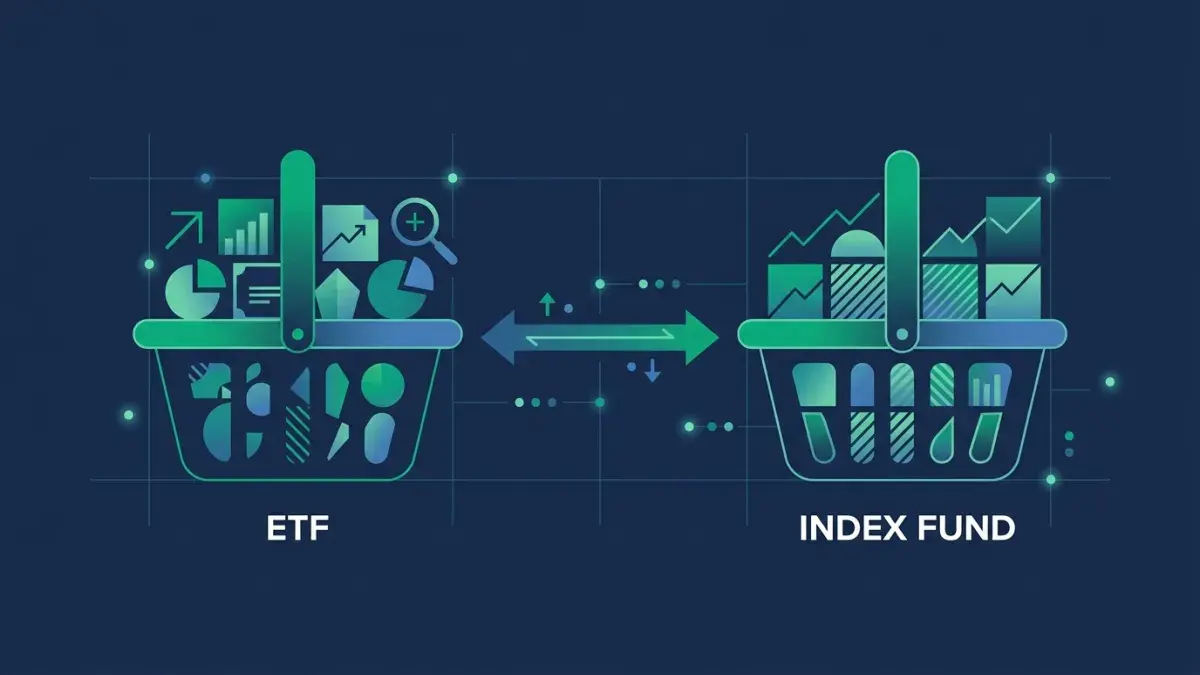
An ETF and an index fund are not opposites. “Index fund” describes a strategy — a fund that passively tracks a market index instead of paying a manager to pick stocks. “ETF” describes a structure — a fund whose shares trade on a stock exchange all day like a stock. The two overlap: most ETFs are index funds, and most index funds come in either an ETF wrapper or a traditional mutual-fund wrapper. The comparison people actually mean is index ETF vs index mutual fund — the same passive strategy in two different packages — and there the real differences are trading, minimums, and tax efficiency, not returns.
“ETF vs index fund” is one of the most common beginner questions in investing, and it is confusing for a good reason: the two words answer different questions, so putting them head-to-head is a bit like asking “sedan vs electric car.” A car can be both. So can a fund. Let’s untangle it.
Two Words, Two Different Questions
“Index fund” is about investment strategy. An index fund holds whatever is in a target index — the S&P 500, the total US market, the Nasdaq-100 — and simply mirrors it. No stock-picking, no manager trying to beat the market, very low cost. The SEC’s investor.gov defines an index fund as a fund whose objective is to track the performance of a specific market benchmark.
“ETF” is about legal and trading structure. An exchange-traded fund is a pooled fund whose shares list and trade on an exchange throughout the day at a live market price, the way a share of a company does. That is different from a traditional mutual fund, which you buy and sell only once per day, after the market closes, at that day’s net asset value (NAV).
Because these are two independent properties, all four combinations exist:
- Index fund that is an ETF — e.g. VOO, VTI, QQQ. The most popular category.
- Index fund that is a mutual fund — e.g. VFIAX (S&P 500), VTSAX (total market).
- Actively managed ETF — a stock-picking fund in an ETF wrapper (ARKK is a famous example). An ETF, but not an index fund.
- Actively managed mutual fund — the classic stock-picking fund. Neither an index fund nor an ETF.
So “is an ETF an index fund?” The answer is: often, but not necessarily. And “is an index fund an ETF?” Same answer.
The Comparison You Actually Want: Index ETF vs Index Mutual Fund
Strip away the terminology and the practical decision is almost always this: you have picked a passive index (say the S&P 500), the same issuer offers it as both an ETF and a mutual fund, and you want to know which wrapper to buy. Here is how the two stack up on the things that actually differ.
| Feature | Index ETF | Index Mutual Fund |
|---|---|---|
| How it trades | Intraday, live price | Once/day at closing NAV |
| Minimum to buy | 1 share or a fraction | Often $1,000–$3,000 |
| Example (S&P 500) | VOO — 0.03% ER | VFIAX — 0.04% ER, $3,000 min |
| Tax efficiency (taxable acct) | Higher (in-kind redemptions) | Good, but more cap-gains distributions |
| Automatic $ investing | Harder (share-based) | Easy (dollar-based) |
| Dividend reinvestment | Broker DRIP (usually free) | Automatic & free |
| Intraday trades / limit orders | Yes | No |
| Best home | Taxable brokerage account | Retirement / auto-invest plans |
Expense ratios and minimums verified on Vanguard’s fund pages (source: VOO and VFIAX). Both track the same S&P 500 index and hold essentially the same portfolio; the differences above are entirely about the wrapper, not the investment.
Cost: Nearly Identical for Index Products
The popular belief that “ETFs are cheaper than index funds” is mostly a hangover from comparing ETFs to actively managed mutual funds, which routinely charge 0.5%–1.0% or more. Between an index ETF and its index-mutual-fund twin, the gap is trivial: VOO at 0.03% versus VFIAX at 0.04% is a difference of $1 per year on $10,000. Over decades that is noise. If you want to see exactly what an expense-ratio gap costs over time, our ETF fee-drag analysis runs the 30-year math on every ratio from 0.03% to 1.00%.
Tax: The One Place the Wrapper Really Matters
In a taxable brokerage account, ETFs generally have an edge. ETFs use an “in-kind” creation-and-redemption mechanism: when large institutional traders exit, the fund hands them a basket of the underlying stocks rather than selling shares for cash, which avoids realizing capital gains that would otherwise be distributed to — and taxed on — every shareholder. Index mutual funds distribute far fewer gains than active funds, and Vanguard’s particular structure narrows the difference, but the ETF still typically wins on tax in a brokerage account.
In a tax-advantaged account — a Roth IRA, traditional IRA, or 401(k) — this advantage disappears entirely, because gains and distributions are not taxed as they occur. If most of your investing happens inside a retirement account, tax efficiency should not drive your ETF-vs-mutual-fund choice at all. (If you are still deciding which account to use, our sister site’s Roth vs traditional IRA breakdown covers the tax trade-off in detail.) For a fuller treatment of the wrapper-level tax differences, see our ETF vs mutual funds comparison.
When Each One Wins
Choose an index ETF if: you are investing in a taxable brokerage account, you want the lowest possible entry point (one share or a fraction), or you value intraday trading and limit orders. For most modern investors opening a brokerage account today, an index ETF like VOO or VTI is the default.
Choose an index mutual fund if: you want to invest a fixed dollar amount automatically every payday without worrying about share prices, and you are doing it inside a retirement account where the tax difference is moot. Automatic dollar-cost averaging is genuinely easier with mutual funds. If you are weighing whether to funnel spare cash into investing versus other goals, our pay-off-mortgage-or-invest guide walks through the math.
The bottom line: for the same index, the ETF and the mutual fund will deliver almost identical long-term returns. Pick the wrapper that fits how you actually invest — and once you have, the more interesting question is which index. Our VOO vs VTI vs SPY breakdown and our VOO vs VTI comparison tool pick up from there.
Caveats
Expense ratios (0.03% VOO, 0.04% VFIAX) and mutual-fund minimums are current as of mid-2026 and can change; verify them on the issuer’s fund page before investing. Broker policies on fractional shares and free ETF dividend reinvestment vary, so confirm with your brokerage. Nothing here is investment advice.